Fred Espenak
To Be Published in Observer's Handbook 2012, Royal Astronomical Society of Canada
The transit or passage of a planet across the face of the Sun is a relatively rare occurrence. As seen from Earth, only transits of Mercury and Venus are possible. On average, there are 13 transits of Mercury each century. In contrast, transits of Venus occur in pairs with more than a century separating each pair.
The last Venus transit was in
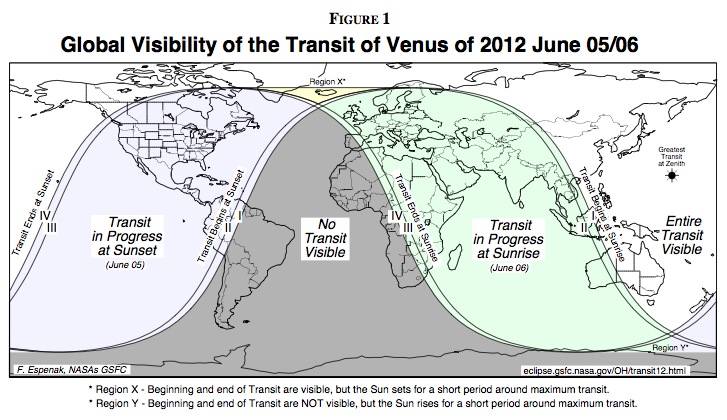
2004 so the second event of the pair will occur on Wednesday, June 6 (Tuesday, June 5 from the Western Hemisphere). The entire event will be widely visible from the western Pacific, eastern Asia and eastern Australia as shown in
Figure 1. Most of North and Central America, and northern South America will witness the beginning of the transit (on June 5) but the Sun will set before the event ends. Similarly, observers in Europe, western and central Asia, eastern Africa and western Australia will see the end of the event since the transit will already be in progress at sunrise from those locations.
For Northern Hemisphere locations above latitude ~67° north, all of the transit is visible regardless of the longitude. Northern Canada and all of Alaska will also see the entire event. Residents of Iceland are in a unique wedge-shaped part of the path (Region X in
Figure 1). They will see both the start and end of the transit but the Sun will set for a short period around greatest transit. A similarly shaped region exists south of Australia (Region Y in
Figure 1), but here, the Sun rises after the transit begins and sets before the event ends.
The principal events occurring during a transit are conveniently characterized by contacts, analogous to the contacts of an annular solar eclipse. The transit begins with contact I, the instant the planet's disk is externally tangent to the Sun. Shortly after contact I, the planet can be seen as a small notch along the solar limb. The entire disk of the planet is first seen at contact II when the planet is internally tangent to the Sun. Over the course of several hours, the silhouetted planet slowly traverses the solar disk. At contact III, the planet reaches the opposite limb and once again is internally tangent to the Sun. Finally, the transit ends at contact IV when the planet's limb is externally tangent to the Sun. Contacts I and II define the phase called ingress while contacts III and IV are known as egress. Position angles for Venus at each contact are measured counterclockwise from the north point on the Sun's disk.
                                         Table 1

                     Geocentric Phases of the 2012 Transit of Venus

                            Event         Universal        Position
                                            Time            Angle

                            Contact I      22:09:38        41°
                            Contact II     22:27:34        38°
                            Greatest       01:29:36       345°
                            Contact III    04:31:39       293°
                            Contact IV     04:49:35       290°
Table 1 gives the geocentric times of major events during the transit. Greatest transit is the instant when Venus passes closest to the Sun's center (i.e. - minimum separation).
During the 2012 transit, Venus's minimum separation from the Sun is 554 arc-seconds (During the 2004 transit, the minimum separation was 627 arc-seconds). The position angle is defined as the direction of Venus with respect to the center of the Sun's disk, measured counterclockwise from the celestial north point on the Sun.
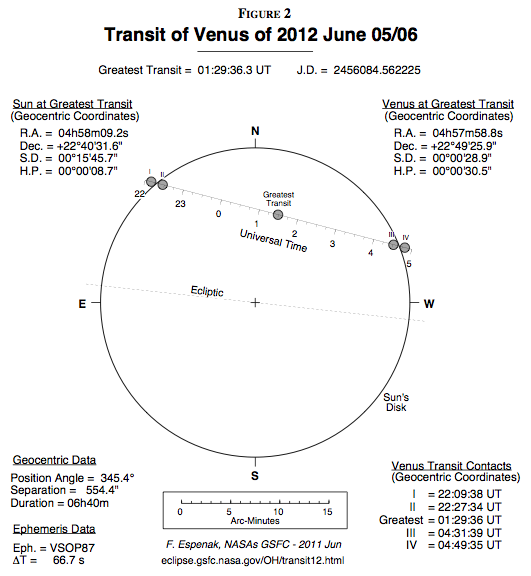
Figure 2 shows the path of Venus across the Sun's disk and the scale gives the Universal Time of Venus's position at any point during the transit. The celestial coordinates of the Sun and Venus are provided at greatest transit as well as the times of the major contacts.
Note that these times are for an observer at Earth's center. The actual contact times for any given observer may differ by up to ±7 minutes. This is due to effects of parallax since Venus's 58 arc-second diameter disk may be shifted up to 30 arc-seconds from its geocentric coordinates depending on the observer's exact position on Earth.
Table 2 and
Table 3 list predicted contact times and corresponding altitudes of the Sun for locations throughout Canada and the United States, respectively.
Table 4 provides similar predictions for a number of cities around the world.
Observing the Transit
Since the apparent diameter of Venus is nearly 1 arc-minute, it is just possible to see without optical magnification (but using solar filter protection) as it crosses the Sun. Nevertheless, the planet appears to be only 1/32 of the Sun's apparent diameter so a pair of binoculars or a small telescope at modest power will offer a much more satisfying view. All binoculars and telescopes must be suitably equipped with adequate filtration to ensure safe solar viewing. The visual and photographic requirements for observing a transit are identical to those for solar viewing. Amateurs can make a scientific contribution by timing the four contacts at ingress and egress. Observing techniques and equipment are similar to those used for lunar occultations. Poor seeing often increases the uncertainty in contact timings, so an estimate of the possible error associated with each timing should be included. Transit timings and geographic coordinates of the observing site (measured with a topographic map or GPS receiver) should be sent to: ALPO Transit Section, c/o Dr. John E Westfall, P.O. Box 2447, Antioch, CA 94531-2447, USA.
White light observations of contacts I and IV are not technically possible since Venus is only visible after contact I and before contact IV. However, if Hydrogen-alpha filtration is available, the planet will be visible against either prominences or the chromosphere before and after contacts I and IV, respectively. Observations of contacts II and III also require amplification. They are defined as the two instants when the planet appears internally tangent to the Sun. However, just before contact II, the so-called black drop effect is seen. At that time, the transiting planet seems to be attached to the Sun's limb by a thin column or thread. When the thread breaks and the planet is completely surrounded by sunlight, this marks the true instant of contact II. Contact III occurs in exactly the reverse order. Atmospheric seeing often makes it difficult to measure contact timings with a precision better than several seconds (see "black drop" effect below).
Frequency of Transits
The orbit of Venus is inclined 3.4° with respect to Earth's orbit. It intersects the ecliptic at two points or nodes that cross the Sun each year during early June and December. If Venus happens to pass through inferior conjunction at that time, a transit will occur. Although Venus's orbital period is only 224.7 days, its synodic period (conjunction to conjunction) is 583.9 days. Due to its inclination, most inferior conjunctions of Venus do not result in a transit because the planet passes too far above or below the ecliptic and does not cross the face of the Sun. Venus transits currently recur at intervals of 8, 105.5, 8 and 121.5 years. Since the invention of the telescope (1610), there have only been seven transits as listed in Table 5.
                                     Table 5

                            Transits of Venus:  1601-2200

                           Date       Universal    Separation
                                        Time

                        1631 Dec 07     05:19         939 "
                        1639 Dec 04     18:26         524 "
                        1761 Jun 06     05:19         570 "
                        1769 Jun 03     22:25         609 "
                        1874 Dec 09     04:07         830 "
                        1882 Dec 06     17:06         637 "
                        2004 Jun 08     08:20         627 "
                        2012 Jun 06     01:28         553 "
                        2117 Dec 11     02:48         724 "
                        2125 Dec 08     16:01         733 "
The 2004 and 2012 transits form a contemporary pair separated by 8 years. More than a century will elapse before the next pair of transits in 2117 and 2125. During the 6,000-year period from 2000 BC to AD 4000, a total of 81 transits of Venus occur. A catalog of these events containing additional details is available online at: